At the edge · Motor racing
The lap he couldn't explain
Qualifying at Monaco in 1988, Ayrton Senna went so far past everyone else that it unsettled him.
Ayrton Senna · Monaco, 1988
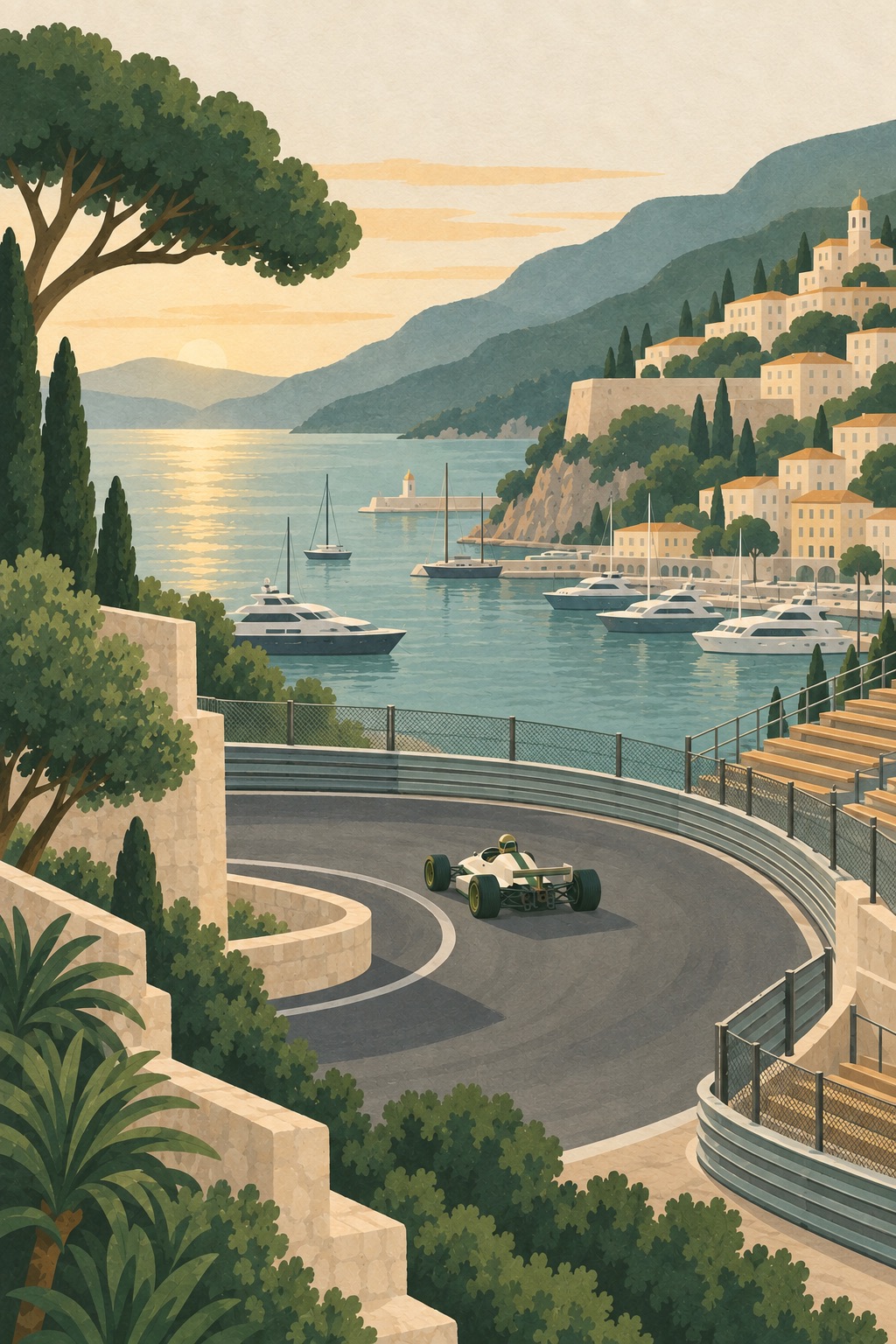
Monaco is a Grand Prix run through the streets of a town: barriers close enough to touch, a tunnel, a harbour, and almost nowhere to pass. So qualifying matters: where you start is very nearly where you finish.
On the Saturday of the 1988 Grand Prix, Ayrton Senna set a time of 1:23.998 in his McLaren-Honda MP4/4. His teammate, Alain Prost, already a world champion and driving the same car, set 1:25.425. The gap was 1.427 seconds, at a track where drivers usually fight over tenths.
Two years later, talking to the journalist Russell Bulgin at Silverstone, Senna tried to describe what had happened on that lap.
I had the feeling that I was in a tunnel; the circuit was just a tunnel for me.
Ayrton Senna, to Russell Bulgin, June 1990
In another account he put it more plainly: he had suddenly realised he was "no longer driving the car consciously."
Knowing when to stop
The part of the story people tend to skip is what he did next. By his own account, the feeling unsettled him. He slowed down and brought the car back to the pits. He had found something at the very limit of what he could do, and he had the judgment to recognise it for what it was.
That's the thing about the edge. The people who reach it aren't careless; they have spent years getting there. His family tells a story from his karting days: after a poor race in the rain, the young Senna went back to the track at Interlagos to practise whenever it rained, until wet weather became one of his great strengths.
The race itself didn't go his way. On Sunday he was leading when he touched the barrier at Portier on lap 67 and crashed out. He didn't go back to the garage. He walked to his apartment nearby, and the team didn't hear from him for hours. Prost won.
It's still the lap people talk about. Not because it won him anything, but because for about a minute and twenty-four seconds someone went all the way into what they did, and came back able to tell us what it felt like.
Sources
Next story
Coffee only